Saturday, July 12, 2014

Lab Update

The last months have been rather busy, which explains somehow why I haven't been posting since quite some time. Well, time now to catch up with what happened recently in the lab! Today's post will deal with the meetings in which the lab was present in the last few months, and I will talk about our recent publications in another (latter) post.

In the last few months, we went to three really fascinating meetings, the PCA/ACA Meeting, the RAI Meeting, and the FENS Forum.

The 44th PCA/ACA National Conference (Popular Culture Association/American Culture Association) was in Chicago, IL, in April. Like always, it was an extremely interesting meeting for me. I love the PCA/ACA meetings for the incredible fresh ideas I get there, stepping from the so diverse approaches and points of view that are displayed there. Cécile Cristofari was also presenting some of our work on the Steampunk community of Second Life there, and got quite a nice feedback.

The Royal Anthropological Institute 2014 Conference: Anthropology and Photography, in the British Museum in May was as well an incredible event. I was the Convenor and Chair of the first session, which was entitled "Anthropology and photography in the digital age". Both Cécile Cristofari and myself gave a talk in this very symposium. We had an amazing feedback, and I was extremely surprised (and pleased) to see how much modern anthropology has incorporated cyberspaces in its practice. As well, I was (again) both surprised and pleased to witness the fact that Computers in Human Behavior had quite a good reputation among those anthropologists interested in the study of social media and other virtual worlds. Beside being in such a prestigious location than the British Museum, the quaility of the talks were mostly of the first order, and we came back with a lot of new contacts and ideas. I even wrote an editorial in Computers in Human Behavior about that (going to be out soon, hopefully). The meeting was preceeded by a few days that I spent at the Future of Humanity Institute of PRof. Nick Bostrom at the University of Oxford. A very interesting experience with a lot of inter-discplinary interactions, very valuable for me, and which elicited quite a few new ideas and angles of view for me.

Introducing the "Anthropology and photography in the digital age" Session
at the RAI Conference at the British Museum

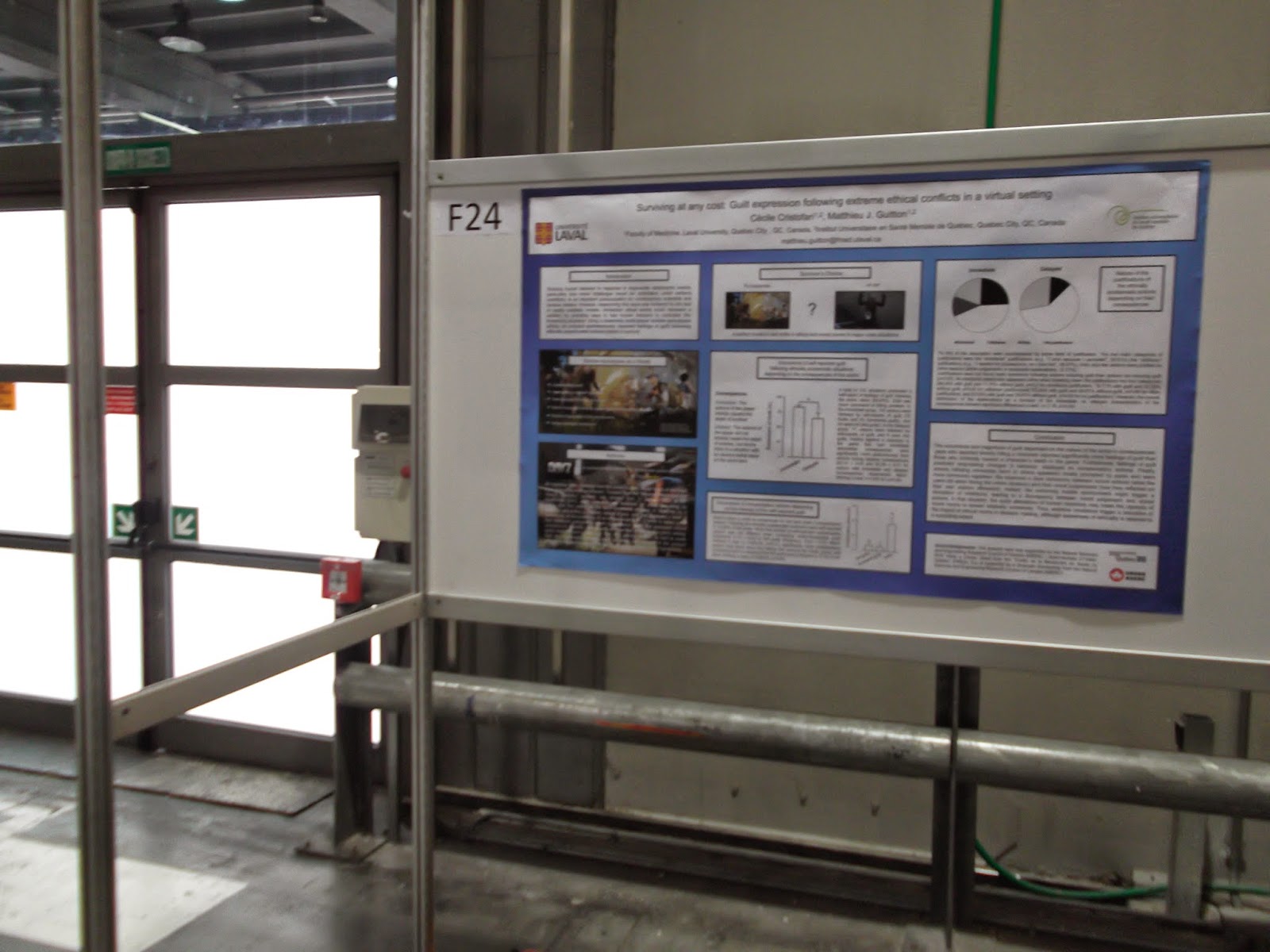
Finally, the 9th FENS Forum of Neuroscience (Federation of European Neuroscience Societies) just took place last week in Milan, Italy. The FENS Meetings are always among my favorite ones, due to a few things, including (but not limited to) the fact that I get to see a lot of my old friends, the fact that peple are somehow less worried to show really innovative and not-yet-published studies (in contrast to the SfN meeting where people usually only show things ready to be published, or actually already published), and to the diversity of approaches in neuroscience that you can see across the different European countries. Now that what I do is slighlty different from purely molecular neuroscience (Well, I always was mostly involved in behavioral neuroscience anyway, but now the focus on interest has clearly drifted to cyberbehavior), I was expecting that what I was doing now would elicit considerably less interest that before among my fellow neuroscientists. Surprisingly for me, that was absolutely not the case. Maybe I got slightly less people at my poster (which was on moral decision making using zombie apocalypse massively online role-playing games as a model, the related paper just got published in PLoS ONE a few days ago) than when I was doing animal model of tinnitus, the quality of the feedback was amazing. I got people who were really interested in some of the various aspects of what we did: virtual spaces, cyberbehavior, decision making process... Who knows, maybe some interesting collaborations might follow?

The entrance of the FENS Forum, at the center of congress of Milan.

Our poster, conveniently located close to an emergency exit...
with zombie invasion, you never know.

Which confirmed my initial observations that scientists are in fact big children.

Computers in Human Behavior flyers at the Elsevier booth.

Monday, December 16, 2013

Google, Facebook, Robots and Artificial Intelligence

It seems a lot is happening in the structuring of the world of robotics and artificial intelligence those days ...

Google and Facebook seems to be playing a game of "who will acquire more ressources" on these two connected fields. Google for instance just got "Boston Dynamics", a well-known (military) quadruped robots, which become the 8th major acquisition of Google in this field, while Facebook is hiring key scientists from the academic world in order to boost its research groups on artificial intelligence.

Why the big players of the Internet world want to invest in artificial intelligence and robots ?

Well, first obvisouly for economic reasons: social network platforms need to diversify their activities, obviously. And artificial intelligence may be a good way to do so, capitilizing on an expertise in algorythms they already have, with important research teams working on such subjects. But not only direct economic outcomes could be foresee. Developping more powerful artificial intelligence paradigms would allow a more efficient use of the data and meta-data these companies are gathering, and therefore, targeting adds more efficiently and ultimately generating more money. Also, it is something to be considered in the light of the Editorial on CHB, where social networks may be a step before the rise of technology-enhanced human group cognition. Same for robotics, it goes in the same line than augmented reality for Internet application.

Interestingly, with the economical power such major companies have, they may well succeed were university researcher failed due to ressources limitations. In any case, it will be interesting to follow ...

Thursday, December 12, 2013

Lab Update

Well, looks like I have not blogged since a few months ...
Not an excuse, I know, but things have been extremely busy in the lab these last months. We launched a few fascinating projects (I know, I am biased), and some already brought some results. Also, we had some major editorial activities, some of them had some nice echoes in the media.

In the last few months, we got a pretty important media coverage, both on our work on tinnitus, and on our works on human behavior in virtual spaces. This included appearance in a few TV show, radio talks, and interviews in local newspapers. That kept me a bit busy, but well, it is important to show to people what we are doing and how research can contribute to advance well-being of people.

Pursuing our research on human behavior in virtual spaces - and, for those who have read some of my recent papers, my interest for popular culture-based virtual settings - we advanced in a fascinating direction: that's it to use immersive virtual spaces as tools to predict human behavior in large-scale crisis. I already have suggested that a few months ago :

Guitton MJ (2013) Editorial: Developing tools to predict human behavior in response to large-scale catastrophic events. Computers in Human Behavior, 29:2756-2757.

but with Dr Cécile Cristofari (postdoc in our team), we pushed things further ... considerably further :

Guitton MJ, Cristofari C (2013) Life in Science: Zombiology. Science, 342:559.

(and two major contributions are on their way, a rather long and comprehensive commentary on public health to be published soon on practical ways to use zombies to implement training tools for health-related organisations, and an experimental study that we just submitted yesterday).

In a logic of anticipating future of humanity, or more specifically, how new technologies could affect it, I also got the following editorial published :

Guitton MJ (2014) Artificial vs. Enhanced Intelligence: Computer or Human Behavior? Computers in Human Behavior, 31:332-333.

a good anniversary milestone discussing some of the unexpected outcomes of half a century or more of research on artificial intelligence.

And we got a few other nice things on their way, including the paper with Dr Anna Lomanowska (her last paper as postdoc in the lab, or first as junior faculty, depending how one looks at it), and another editorial on the "dark side" of social networks :

Lomanowska AM, Guitton MJ (2014) My avatar is pregnant! Representation of pregnancy, birth, and maternity in a virtual world. Computers in Human Behavior, 31:322-331.
Guitton MJ (2014) The importance of studying the dark side of social networks. Computers in Human Behavior, 31:335.

And with the new coming year, we are having a lot of new projects too !
One of them is of course the conference of the Royal Anthropological Institute, which will be held in the British Museum May 29th to May 31st, and in which I am the convenor and chair of the first panel on "Anthropology and photography in the digital age". Call for paper is open, so people interested, please have a look and submit !

More updates to come in future blog posts !

Tuesday, July 9, 2013

Lab Update

Well, I just got officially promoted as member of the Editorial Board of the newly journal "Advances in Medicine", in the Otolaryngology section. Always pleasant for the ego, of course. But I want to mention here a few of the reasons why I accepted to be part of this adventure.

First, what has made me hesitate. New journals are always a risk : you never know what will be their fate and if they will survive the few first issues. Furthermore, what will be their quality, and impact factor is unknown obviously.

But second - and in the present case, more important - is what has made me think it was something I should do. The format of the journal : it is a journal which is taking ONLY reviews ... meaning, we go back to the original format of the "progresses" and "advances" series. It is not another journal aiming to publish any experimental work just to create more "background noise", but a journal which specifically will provide the scientists a forum to summarize, synthezise, digest knowledge, to put the most recent advances in perspective. Not to do primary research, but to give to people the tools to understand it. With the tremendous increase of the quantities of published work (sometimes not always of the best methodological quality), the need for accurate and authoritative reviews is critical. Sending reviews to a regular journal is dangerous : the regular journals are not supposed to take all of them (as they are usually primarily targetted to innovative research), and will mostly take a few "invited reviews" ... which, despite being often of excellent quality, can by definition not cover all the spread of a field, but only a few particular subjects and topics. Another point which took my decision is the fact that this new journal covers almost all the fields of current medicine (Anesthesiology, Cardiology, Critical Care, Dentistry, Dermatology, Emergency Medecine, Endocrinology, Epidemiology, Gastroenterology, Genetics, Geriatrics, Hematology, Hepatology, Immunology, Infectious Diseases, Nephrology, Neurology, Oncology, Ophthalmology, Orthopedics, Otolaryngology, Pathology, Pediatrics, Preventive Medicine, Psychiatry, Public Health, Pulmonology, Rehabilitation, Rheumatology, Surgery, Transplantation, Urology, Vascular Medicine). Advances in Medicine is not a purely "specialty-related" journal, it rather offers the potential to act as a constantly updated medical encyclopedia of a constantly growing corpus of knowledge. I see the potential of such a journal not only for scientists and other researchers, but for practitioners and students alike.

Anyway, let's see how this journal goes, and wish it the best successes !

Wednesday, July 3, 2013

Literature Update

The issue of November of Computers in Human Behavior (issue still in progress) looks so far very good. I selected here a few papers dealing with a lot of interesting topics.

First, a series of two papers regarding two aspects of age-dependent online use. One on the impact of virtual spaces on adolescents’ sense of identity, and one on the effect of sharing virtual experience between people from different generations on intergenerational cohesion.

Davis K (2013) Young people’s digital lives: The impact of interpersonal relationships. and digital media use on adolescents’ sense of identity. Computers in Human Behavior, 29;2281–2293.
Chua PH, Jung Y, Lwin MO, Theng YL (2013) Let’s play together: Effects of video-game play on intergenerational perceptions among youth and elderly participants. Computers in Human Behavior, 29;2303–2311.

Something interesting regarding (cyber)psychopathology (at large), on the profiles of college cyberbullies.

Schenk AM, Fremouw WJ, Keelan CM (2013) Characteristics of college cyberbullies. Computers in Human Behavior, 29;2320–2327.

Must be read just before or just after our paper on Internet addiction (Lortie CL, Guitton MJ (2013) Internet addiction assessment tools: dimensional structure and methodological status. Addiction, 108:1207-1216. [PDF]), for a more global view on cyberpathologies.

Internet privacy and sexualisation in virtual spaces are important topics, and here is an interesting paper on that.

Beaussart ML, Kaufman JC (2013) Gender differences and the effects of perceived internet privacy on self-reports of sexual behavior and sociosexuality. Computers in Human Behavior, 29;2524–2529.

And finally, a paper on data mining and analysis of Twitter threads.
Purohit H, Hampton A, Shalin VL, Sheth AP, John Flach J, Bhatt S (2013) What kind of #conversation is Twitter? Mining #psycholinguistic cues for emergency coordination. Computers in Human Behavior, 29;2438–2447.

Wednesday, June 5, 2013

Comment: on Open Access

I know that what I will say is going against the main stream, but alternative points of view are important as well. As we can all see by the incredible number of new Open Access journals flourishing daily and harassing scientists and other scholars via filling email boxes with invitation to submit a paper there, Open Access it now very fashionable. And as we can read in Nature, there is a global movement even in funding agencies to promote Open Access, as a wider way to spread scientific results.

Of course, nothing can be said against the fact that, once published, we all would want our results to be accessible as largely as possible.

However, there are some risks as well.
With the former publishing model, in which Authors submit an article to a peer-reviewed journal, the Authors who do the experiments and write the paper do not have to pay more. If accepted, the paper gets published in the journal, and it is readers who will pay via (individual or institutional) subscription, or with a pay-per-view system. I don't want to discuss here the question of the pricing of the subscriptions, which can reach extremely high levels for universities which often have to maintain active tremendously large collections. Money is sparse, so often universities unfortunately have to make choice. But in this "classical" model, the interest of the journal is to only accept the best papers, so the reputation of the journal will stay high, and consumers will be willing to pay to keep their subscription.
With the Open Access model, it is a bit different. Authors submit an article to peer-reviewed journal. But, if the paper is accepted, the Authors have to PAY to make sure that the paper will be in Open Access, meaning freely accessible by anyone anytime. Great, but nothing is free, it is in fact the Authors who pay for that. Meaning, not only the Authors have to do the experiments, to write the paper, and to finally pay to have it published. Given that Reviewers work for free, the money goes all in the journal. I am not saying that the journal does not have fees and people to pay. Nor I am saying that it is a bad system. There are some excellent peer-reviewed Open Access journals, the first names coming in mind being PLoS ONE (which initiated the movement) and the Frontiers series. But still, in such a model, the interest of the journal is not necessary anymore to insure the highest level of publication, but to get the most papers published, since the money is not coming from the copies of the journal purchased (linked to the intrinsic quality of the papers inside the journal and to the overall reputation of the journal), but from the number of papers published. And hence, here is the danger to go for quantity over quality.

Having said that, I myself publish a lot of papers in Open Access journals, so I am not fundamentally against this idea (not at all). Just, I believe we still need to find the optimal way to articulate the Open Access model of publishing with the more traditional systems, in order to keep the quality of published science: only keeping the highest quality for publishing research (whatever the field, whatever the Impact Factor) can pave the way to human progress.

Thursday, May 23, 2013

Lab Update

Very long time I did not post something, sorry ... A lot of interesting projects going on, which kept me busy from updating. But now, it is really time for a small update !

A lot of good things happened in the lab in the last few months, here is a short summary.

First and foremost, our approach of virtual anthropology to study cyberbehavior and virtual worlds is so far extremely rewarding. We are advancing really well on different directions, and have enough data to launch a few long-term projects (some of them having keep me away from posting and tweeting recently). As a general update, I got elected as a Fellow of the Royal Anthropological Institute a few month ago and got promoted Associate Editor for Computers in Human Behavior (going to be official in the coming days or weeks). I can not stress enough how much I consider that this journal has an amazing potential. It is one of the oldest and clearly most prestigious academic journals on human behavior in virtual spaces, and, in contrast to most of the other journals of the field, it is trully inter-disciplinary. I was already part of the Editorial Board, and I am glad that I will be able to work more to do my best to push the journal forward.

Enough about me, now regarding the lab people ! Dr Anna Lomanowska is going to become Assistant Professor at the School of Psychology June 1st. But nonetheless, her postdoctoral grant to work in my lab got renewed one more year. And Catherine Lortie got the extremely prestigious Alexander Graham Bell grant from the three Research Council of Canada for outstanding students and research projects, which is given only to the 100 best canadian students. Of course, I am lucky to have such good people in my lab. But that also reinforces me in the idea that we should probably be doing good research, and that our working hypothesis go in the good direction.

And indeed, it shows with the publications. Since the last post (wow, was it really in January ? Shame on me !), we got a few more papers published :

Achim A, Guitton M, Jackson P, Boutin A, Monetta L (2013) On what ground do we mentalize? Characteristics of current tasks and sources of information that contribute to mentalizing judgments. Psychological Assessment, 25:117-126.

In fact, this paper was Epub ahead of Print since a good 6 months. But now at least, it is fully published. Worthy of note, it already elicited some comments and debates, which is always a good sign ...

Lortie CL, Guitton MJ (2013) Internet addiction assessment tools: dimensional structure and methodological status. Addiction, [7 May 2013, Epub ahead of print].

This paper is going to be a "must-quote", honestly. We performed a in-depth review of the different questionnaires and assessment tools developed so far to evidence Internet addiction, and we attempted to extract from the meta-analysis the general trends of how people in the field actually do perceive Internet addiction. So far, we already got some pretty good feedback. Catherine presented it in Nice at the 21st European Congress of Psychiatry (EPA) and is currently at Toronto presenting it at the Canadian Association for Neuroscience annual meeting.

Guitton MJ (2013) Telemedicine in Tinnitus: Feasibility, Advantages, Limitations and Perspectives. ISRN Otolaryngology, 2013 (2013), Article ID 218265.

With this paper, I am pretty happy. We are now succeeding to apply a bit of what we studied on human behavior in virtual spaces to medical problematics, and particularly to some which are close to my heart. More on this subject is coming soon (we are working on a few projects on tele-medicine in otolaryngology, going to be really interesting !).

And the work I presented at the PCA/ACA meeting a few months ago on the morphological conservation in human-animal hybrids in science fiction and fantasy settings (is our imagination as free as we think it is?) is now accepted for publication in Advances in Anthropology.

On the "molecular" side of our research, we have not been inactive either, with two papers published or accepted since January, both in the extremely prestigious Journal of Neuroscience :

Bories C, Husson Z, Guitton MJ, De Koninck Y (2013) Differential balance of prefrontal synaptic activity in successful versus unsuccessful cognitive aging. Journal of Neuroscience, 33:1344-1356.

and the coming accepted paper :

Arsenault D*, Dal-Pan A*, Tremblay C, Bennett DA, Guitton MJ, De Koninck Y, Tonegawa S, Calon F (Accepted) PAK inactivation impairs social recognition in 3xTg-AD mice without increasing brain deposition of tau and Abeta. Journal of Neuroscience, Accepted.

And, as a final note for this long update post, we are always looking for amazing PhD students and striking post-doctoral fellows to work on our research thematics. I have a lot of idea to explore both virtual worlds and human behavior in these virtual spaces, so do not hesitate to contact me if that sounds appealing to you !